Breaking News
Crore Taka Broom Stick Industry in Nazirpur, Pirojpur.
Reporter :
Editor :
National
>
Borisal
09 September 2026 09:13 AM
170
Views
G.M. Adol,
Pirojpur District Correspondent.
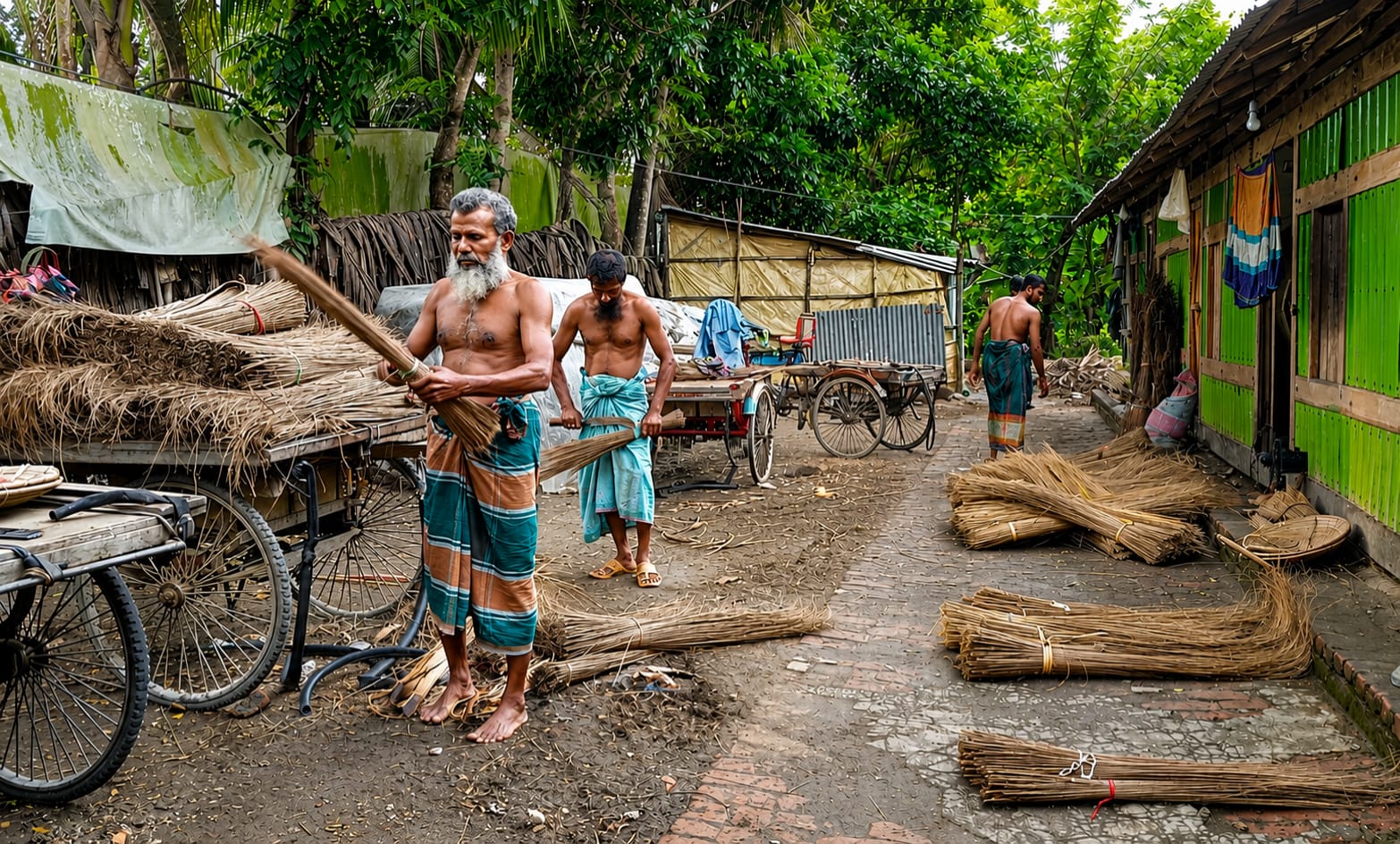
What was once considered nothing more than fallen leaves has now become a source of livelihood for many people, generating a business worth crores of taka.
In different areas of Nazirpur Upazila in Pirojpur, a quiet cottage industry has developed around the collection, drying, sorting, bundling and marketing of broom sticks made from coconut leaves. These sticks, produced in homes across the rural areas, are sold not only in local markets but also transported to different parts of the country.
Although they may appear simple, the production of broom sticks involves a long chain of activities.
The work begins early in the morning with collecting and sorting coconut leaf sticks. Some workers separate the sticks from dried coconut leaves, while others clean and straighten them. The sticks are then arranged according to size and bundled together. Finally, wholesalers collect the bundles and transport them to various markets.
Both men and women are involved in this industry in the rural communities of Nazirpur. In particular, many women engage in producing and processing broom sticks alongside their household responsibilities, earning additional income for their families. As a result, the industry has become more than just a cottage based activity. It has emerged as an alternative source of employment for many households.
One of the major advantages of the industry is that it requires neither expensive machinery nor large infrastructure. Workers can produce the sticks at home using locally available raw materials, allowing people to enter the business with relatively little capital.
A wholesaler involved in the industry first collects coconut-leaf sticks from different households. The sticks are then dried and sorted, with damaged and unsuitable pieces separated from the good ones. Strong and clean sticks are arranged in specific quantities and tightly bundled for sale.
Women’s participation is another important feature of the industry in Nazirpur. Many rural women clean, sort and bundle broom sticks during their free time while continuing their household responsibilities. This allows them to earn an income through their own labour even when other members of their families are engaged in different occupations.
A local woman involved in the industry said, “I make broom sticks in between my household chores. If I can produce a good number every day, it helps contribute to our household expenses. I can also earn some extra money for myself and my children. The work is convenient for us because it can be done from home.”
A significant portion of the broom sticks produced in Nazirpur is sold in local markets, while some are transported outside the district through wholesalers. Wholesalers travel from village to village, collecting the sticks from households before supplying them to different markets. From there the products eventually reach consumers through retail traders.
In this way, the coconut-leaf broom-stick industry has created a multi-layered commercial chain in Nazirpur, involving raw-material collectors, workers, artisans, local traders, wholesalers and retailers. Each group earns income from the industry in one way or another.
At first glance, the broom-stick production scattered across small homes and yards in Nazirpur may seem insignificant. However, considering the number of people involved, daily production, supply to local and outside markets, and wholesale transactions, the industry carries considerable economic importance.
According to local residents and traders, the annual volume of business generated by the industry could exceed Tk 1 crore if properly calculated. However, determining the exact size of the industry would require a comprehensive survey covering production, wholesale sales and marketing activities.
Despite its potential, people involved in the industry face several challenges. These include shortages in raw-material supply, transportation costs, labour expenses, fluctuations in wholesale prices and the involvement of middlemen, all of which can reduce their expected profits.
Traders, workers and artisans involved in the local broom-stick business said that although they put in significant labour to produce the sticks, a substantial portion of the market value is often consumed by transportation costs.
Those involved in the profession also expressed frustration over the lack of government support and access to loans. They said, “We have never received government assistance or loans. If we received financial support or easy-term loans, we could expand this business further.”
The promising cottage industry of Nazirpur could become a significant small-scale industrial sector if it is developed in a planned manner. Training for artisans, easy access to loans, improved raw-material collection systems, quality packaging, direct connections with wholesale markets across the country and abroad, and opportunities for online marketing could significantly expand the broom-stick industry.
Local residents and people involved in the industry believe that branding broom sticks produced in Nazirpur and marketing them across different regions of Bangladesh could increase their value. The products could also be promoted as environmentally friendly, natural alternatives, creating a distinct market for them.
With proper planning, financial support and market expansion, the humble coconut-leaf broom stick could become an important source of employment and income for rural communities in Nazirpur while contributing to the local economy of Pirojpur.
Related News